How to Fix My IBD or IBS Naturally
First, Let’s Retire the Word “Fix” for a Minute
Typing “how to fix my IBD or IBS naturally” into Google usually happens after a person has already been through the digestive health obstacle course. You tried eating cleaner. You tried avoiding dairy. You tried fiber. You tried less fiber after fiber betrayed you in public. You bought the probiotic with the glowing reviews and the price tag of a small appliance. You may have tried the low-FODMAP diet and watched your grocery list shrink into a sad little hostage situation.
So let’s start with the truth, because your gut deserves better than another sparkly wellness promise wearing linen pants. IBS and IBD are different conditions. They can overlap in symptoms, but they are not the same beast wearing two name tags. IBS, or irritable bowel syndrome, is a disorder of gut function and gut-brain communication that can cause abdominal pain, bloating, gas, diarrhea, constipation, urgency, or mixed bowel habits. IBD, or inflammatory bowel disease, includes Crohn’s disease and ulcerative colitis, and involves inflammation that can damage the digestive tract. That distinction matters. A lot. Like “do not bring a smoothie to a house fire” a lot.
If you are still unclear on that difference, start with IBS vs. IBD: What’s the Difference? and then come back here. The short version: IBS can be miserable without causing visible intestinal damage, while IBD requires medical monitoring because inflammation can create serious complications. Natural support can matter for both, but the plan changes depending on what your body is actually dealing with.
At GassyGuts, we like practical honesty. Natural gut healing does not mean pretending medication is evil, acting like every doctor is useless, or believing one herb can resolve a complex digestive condition because someone with great lighting said so online. Natural means working with the body’s real systems: food tolerance, inflammation, motility, stress, sleep, hydration, microbiome support, stool patterns, nervous system regulation, and medical clarity. Revolutionary stuff, apparently.
The National Institute of Diabetes and Digestive and Kidney Diseases explains that IBS diet changes may include eating more fiber, avoiding gluten, or using a low-FODMAP diet, but different changes help different people. That tiny sentence is the whole circus. Different people need different changes. The gut is personal. It has opinions. Some of those opinions are rude, loud, and poorly timed, but they are still information.
Mayo Clinic also notes that mild IBS symptoms may improve through stress management and diet and lifestyle changes, including avoiding trigger foods, eating high-fiber foods when tolerated, drinking fluids, regular exercise, and sleep. For IBD, the conversation becomes more medically serious. The Crohn’s & Colitis Foundation emphasizes individualized nutrition, and the American Gastroenterological Association states that a Mediterranean-style dietary pattern can support overall health and well-being in IBD, while no single diet has consistently been shown to reduce adult IBD flare rates. Translation: food matters, but food is not a magic wand. Humanity remains furious about this.
The Natural Gut Healing Trap
The biggest mistake people make when trying to fix IBS or IBD naturally is chasing villains. Gluten is the villain. Dairy is the villain. Beans are the villain. Seed oils are the villain. Coffee is the villain. Garlic is basically Voldemort with flavor. Sometimes a food really is a trigger. Sometimes the problem is the dose, the timing, the form, the flare status, the stress load, the speed of eating, the constipation underneath, or the fact that your gut has been living like a smoke alarm with abandonment issues.
Trigger-hunting can help for a while. Then it can turn into food fear. Food fear makes people smaller. Smaller plates. Smaller social lives. Smaller confidence. Smaller joy. And eventually, smaller nutrient diversity, which is exactly the opposite direction many guts need once they are ready to rebuild.
That is why we approach natural IBS relief and natural IBD support as a layered plan, not a punishment diet. The goal is not to win an imaginary purity contest. The goal is to calm symptoms, protect nutrition, rebuild tolerance, identify patterns, reduce digestive chaos, and give people a path back to food without the usual drama parade.
Start With a Plan, Not Another Panic Diet
If you are tired of trying random tips while your stomach behaves like a haunted accordion, explore GassyGuts services. Our ecosystem is built for people who want personalized gut support, symptom clarity, Phyto Diet guidance, stress tools, and a realistic path forward. Natural gut healing should feel like strategy, not like you are being sentenced to boiled chicken and vibes.
The GassyGuts Natural Fix Framework
Step 1: Get the Diagnosis Straight Before You Start “Healing” Everything
Before making a natural gut healing plan, know what you are working with. IBS, IBD, celiac disease, microscopic colitis, bile acid diarrhea, constipation, pelvic floor dysfunction, SIBO, infections, medication side effects, lactose intolerance, gallbladder issues, endometriosis, thyroid problems, and anxiety-driven gut-brain patterns can all walk into the room wearing similar symptom outfits. Biology loves bad branding.
If your symptoms include blood in stool, black stool, unexplained weight loss, fever, anemia, persistent vomiting, dehydration, severe worsening pain, nighttime diarrhea, or a major change in bowel habits, get medical care. If you have IBD, keep working with your gastroenterologist. Mayo Clinic describes IBD treatment as focusing on reducing inflammation and may include anti-inflammatory drugs, immune system suppressors, biologics, antibiotics, nutrition support, or surgery in some cases. Natural support belongs beside good medical care, not in a fistfight with it.
For IBS readers, diagnosis can still feel strangely unfinished. Many people are told they have IBS and then sent home with “try fiber” and “reduce stress,” which is impressive advice for a species that invented group texts. Our article Diagnosed With IBS But Given No Answers? What to Do Next walks through that exact frustration. An IBS diagnosis should be the beginning of a map, not the end of the conversation.
Step 2: Track Patterns Like a Detective, Not Like a Scared Squirrel
The first natural fix is data. Not obsessive data. Not twelve spreadsheets, a food scale, and an emotional breakdown over cumin. Useful data. For two to four weeks, track food, timing, symptoms, stool pattern, stress, sleep, and what helped. Rate bloating from 0 to 10. Note diarrhea, constipation, urgency, incomplete evacuation, mucus, pain location, and whether pain improves after a bowel movement. Track symptoms the next morning too, because delayed reactions exist and they enjoy ruining simple conclusions.
This matters because “I bloated after lunch” is too vague. Was lunch large? Fast? High fat? High FODMAP? Carbonated? Eaten during stress? Was there constipation from the previous two days? Was sleep terrible? Was it during an IBD flare? Did you eat raw vegetables on a gut that currently prefers cooked food and emotional distance?
A pattern log helps separate true food triggers from innocent bystanders. It can show that bloating builds through the day, suggesting constipation or gas trapping. It can show diarrhea after coffee, fatty meals, alcohol, or stress. It can show gas after large servings of beans, onions, wheat, apples, or sugar alcohols. It can show symptoms after “healthy” foods because the gut may need smaller portions, cooked textures, lower residue during flares, or a slower fiber ramp.
This is where natural support becomes personal. Will This Gut Pain or Gas Ever Stop? explains why symptoms often persist when people chase single causes. A smarter gut plan reads the pattern, then chooses the smallest useful experiment.
Step 3: Use Food as Information, Not Evidence of Your Failure
Food is information. This sentence belongs on a mug, preferably one that does not contain coffee if coffee sends you sprinting toward the bathroom like a contestant on a cursed game show.
For IBS, food strategy often begins by calming the obvious irritants. Large meals, carbonated drinks, alcohol, sugar alcohols, greasy foods, too much caffeine, rapid eating, and giant fiber jumps can all worsen symptoms. For some people, lactose, wheat, high-FODMAP foods, or certain fruits and vegetables become major triggers. The NIDDK notes that IBS dietary changes may include fiber, gluten avoidance, or low-FODMAP guidance, and that different changes help different people. This is why the answer is never “everyone should eat this exact list.” That would be convenient. Naturally, the body declined convenience.
For IBD, food strategy has to respect disease activity. During a Crohn’s or ulcerative colitis flare, high-fiber raw foods, skins, seeds, nuts, greasy meals, alcohol, and lactose may worsen symptoms for some people. During remission, many people can work toward broader nutrition, more tolerated plant foods, lean proteins, healthy fats, and a Mediterranean-style pattern if appropriate. The Crohn’s & Colitis Foundation highlights how food needs can shift during flares versus steadier periods. The AGA recommends a Mediterranean-style diet rich in fruits and vegetables, monounsaturated fats, complex carbohydrates, and lean proteins for overall IBD health when there is no contraindication, while also noting no diet has consistently reduced adult flare rates. That is nuanced, which means the internet will hate it.
The GassyGuts version is simple: calm first, rebuild second. If your gut is in chaos, start with easier foods, smaller portions, cooked textures, hydration, and consistency. Once symptoms steady, rebuild variety slowly. Natural gut healing is less like flipping a switch and more like teaching a dramatic toddler to trust vegetables again.
Step 4: Build a Phyto Diet Ladder Instead of Jumping Into a Plant Volcano
The Phyto Diet is not about dumping thirty raw plants into a sensitive digestive system and hoping your colon writes a thank-you note. Phyto means plant, but a plant-forward gut plan needs timing, texture, dose, and tolerance. A bloated IBS gut or inflamed IBD gut may not love raw kale, giant salads, beans, broccoli, onions, garlic, apples, and chia pudding all in one enthusiastic wellness avalanche.
Instead, use a Phyto Diet ladder. Start with gentle plant inputs your gut can actually handle. Think cooked carrots, peeled zucchini, squash, potatoes without skin if needed, rice bowls with herbs, oats if tolerated, bananas, blueberries, soups, blended vegetables, ginger, turmeric, olive oil, small servings of ground flax or chia gel, and tiny amounts of legumes later if tolerated. This is plant diversity with manners.
The Harvard Nutrition Source explains that diet plays a major role in shaping the gut microbiome and that fiber-rich foods are fermented by gut bacteria into short-chain fatty acids. That does not mean more fiber tomorrow morning until your intestines inflate like a parade balloon. It means fiber and plant variety can support long-term microbial health when introduced in forms your gut can tolerate.
Here is a creative way to use this: make a “tolerance shelf.” Put foods into three categories. Green foods feel safe most of the time. Yellow foods are tolerated in small amounts, cooked, blended, peeled, or paired with simpler meals. Red foods are currently too loud. Red does not mean banned forever. It means “later, with adult supervision.” This keeps people from treating food like a moral courtroom.
A Phyto Diet ladder might look like this: Week one, stabilize meals with simple proteins, gentle starches, cooked vegetables, and hydration. Week two, add one new plant every two to three days in a small portion. Week three, test texture changes, like cooked spinach before raw greens. Week four, add diversity toppers: herbs, a spoon of seeds, tolerated berries, olive oil, or a small portion of lentils. The goal is progress your gut can metabolize, not a social media challenge.
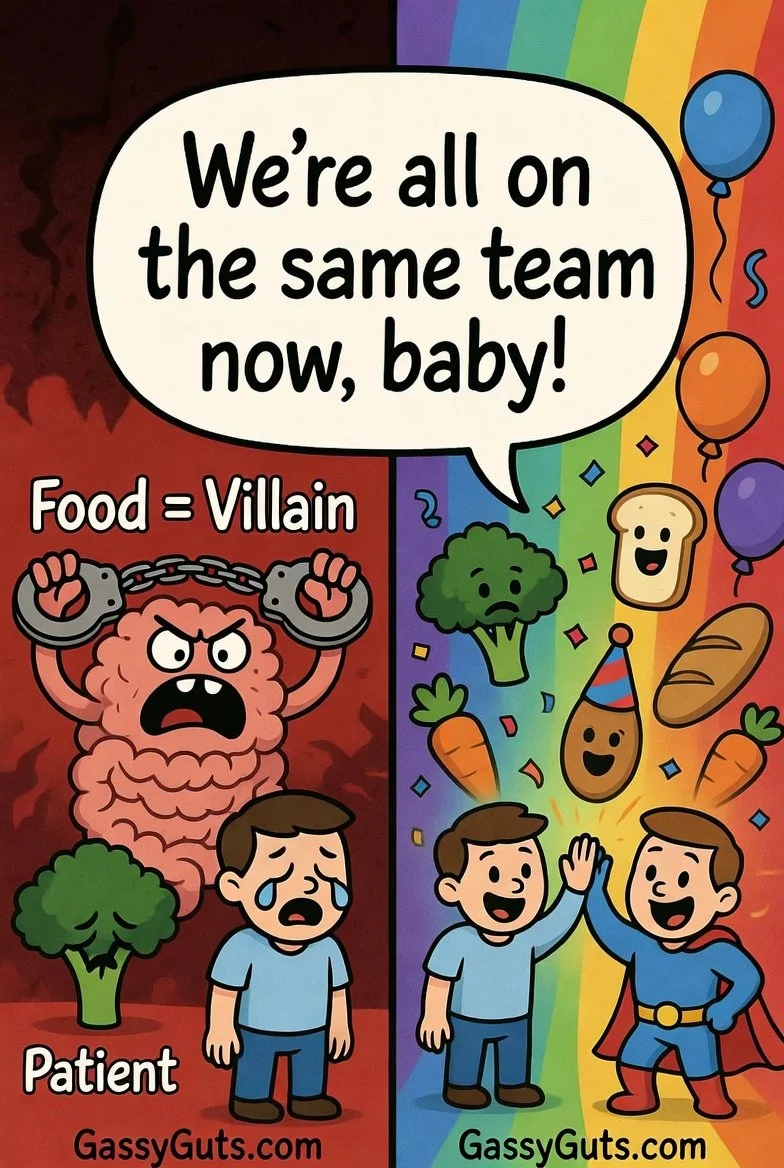
Food was never meant to be a supervillain!
Step 5: Fiber Is a Tool, Not a Personality
Fiber advice ruins lives when delivered lazily. “Eat more fiber” can help some people and flatten others like a digestive tax audit. Soluble fiber is often gentler for IBS, especially constipation-predominant IBS. The American College of Gastroenterology guideline supports soluble fiber for global IBS symptoms, while Mayo Clinic notes fiber should be increased gradually and highlights soluble fiber, such as psyllium, over insoluble wheat bran in IBS research.
Practical translation: start low and slow. Psyllium may help some people, but begin with a small amount, use plenty of water, and track response. Food-based soluble fiber can come from oats, peeled cooked apples if tolerated, bananas, carrots, chia gel, ground flax, potatoes, and certain soft-cooked vegetables. Insoluble fiber, especially rough raw vegetables, bran, skins, and seeds, may aggravate symptoms for some sensitive guts or during IBD flares.
For diarrhea-predominant IBS, soluble fiber may help stool form. For constipation-predominant IBS, it may help soften and move stool. For mixed IBS, caution matters. For IBD, flare status matters. During active inflammation, strictures, narrowing, severe diarrhea, or recent surgery, fiber choices should be discussed with a medical team or dietitian. The gut is not impressed by bravery when there is a stricture involved.
Step 6: Stop Worshiping Supplements Like Tiny Plastic Gods
Supplements can help. Supplements can also waste money, confuse the picture, worsen symptoms, or make someone feel like healing requires a cabinet full of capsules with names that sound like rejected Star Wars planets.
Peppermint oil has evidence for IBS symptom relief and is supported in the ACG IBS guideline, but it may worsen reflux for some people, especially if it is not enteric-coated. Probiotics are more complicated. Some people feel better with specific strains. Others bloat more. Evidence varies by strain, symptom type, dose, and person. Digestive enzymes can help when a specific intolerance is involved, such as lactase for lactose intolerance, but they are not universal fairy dust.
If you use natural remedies, test one at a time. Give each trial a clear purpose. Are you trying to reduce spasms, improve stool consistency, support motility, calm reflux, reduce gas, improve tolerance, or support nutritional gaps? Track the result. Keep what works. Release what does nothing. Your gut plan should not become a subscription box with bowel movements.
For more ideas in this lane, read 9 Natural Remedies for Healing IBS and IBD, but keep the grown-up rule: natural does not automatically mean safe, necessary, or right for you. Check interactions, pregnancy considerations, reflux, liver issues, kidney issues, IBD medications, immune suppression, and procedure timing with a qualified professional.
Step 7: Make Stress Useful Instead of Letting It Become the Scapegoat
Stress does not mean your symptoms are imaginary. Stress means your nervous system and digestive system are connected, because apparently the body decided email should influence bowel motility. The NIDDK includes mental health therapies among IBS treatment options, and Mayo Clinic includes stress management as part of IBS care. Gut-brain support is not fluffy. It is physiology wearing comfortable pants.
Natural IBS relief often improves when the nervous system gets a seat at the table. Try three minutes of slow breathing before meals. Walk for ten minutes after eating. Build a boring sleep routine, which is deeply annoying and often effective. Use heat for cramps. Practice meal pacing. Do gentle movement during constipation-heavy weeks. Try gut-directed therapy, CBT, hypnotherapy, mindfulness, or somatic work if stress and symptoms are fused together like two raccoons in a trash can.
How to Relax Your Gut gives readers a more practical entry point into breathwork, movement, meditation, journaling, and laughter. None of this replaces IBD medical care. None of this means stress caused everything. It means the gut calms more easily when the whole body receives fewer alarm signals.
Step 8: Create a Flare-Day Plan and a Rebuild-Day Plan
One reason gut healing advice fails is that it gives the same meal plan for every day. But a flare day and a rebuild day are different animals. A flare day may require gentle, lower-residue foods, smaller meals, hydration, electrolytes, rest, medication adherence, medical follow-up when needed, and fewer experiments. A rebuild day may invite more plant variety, soluble fiber, fermented foods if tolerated, balanced meals, and careful food reintroduction.
For IBS flare-style days, consider simple meals: rice with eggs, chicken soup, oats if tolerated, potatoes, bananas, cooked carrots, zucchini, broth, ginger tea, or lactose-free options. For IBD flares, work with your medical team, especially if symptoms include bleeding, fever, weight loss, severe pain, dehydration, or frequent diarrhea. Food texture, fiber level, hydration, and medication plans matter.
For rebuild days, bring back color and variety slowly. Add herbs. Add cooked vegetables. Add tolerated fruits. Add soluble fiber. Add olive oil. Add fermented foods in tiny portions if tolerated. Add legumes like they are spices at first, not the main event. Your gut may handle two tablespoons of lentils long before it handles a lentil bowl large enough to frighten furniture.
Step 9: Use the 3-2-1 Gut Reset Plate
Here is a simple creative framework: the 3-2-1 Gut Reset Plate. Three steady anchors, two gut-supportive upgrades, one experiment.
The three anchors are protein, gentle carbohydrate, and tolerated plant color. Protein may be eggs, fish, chicken, tofu, turkey, yogurt if tolerated, or another option that works for your body. Gentle carbohydrates may include rice, potatoes, oats, quinoa, sourdough if tolerated, or squash. Tolerated plant color may be cooked carrots, zucchini, spinach, blueberries, peeled cucumber, squash, herbs, or tomato if tolerated.
The two upgrades are hydration and calming support. Hydration can be water, oral rehydration when needed, ginger tea, or broth. Calming support can be a short walk, slow breathing, heat, mindful eating, or eating without doom-scrolling the digital sewer.
The one experiment is a small, intentional test: a new cooked vegetable, a teaspoon of ground flax, a small portion of berries, a tiny serving of lentils, a lactose-free dairy trial, or a caffeine reduction. One experiment at a time. This keeps the plan readable. When people change seven variables at once, the gut sends back a symptom receipt written in chaos.
Step 10: Know When Natural Support Is Working
Natural gut support is working when symptoms become less random. You may still have IBS or IBD. You may still have sensitive days. But progress looks like fewer surprise attacks, clearer triggers, better stool consistency, less bloating intensity, shorter flare recovery, more tolerated foods, less panic around meals, and a better sense of what your gut is asking for.
It can also look emotionally ordinary: going out to eat with a plan, traveling without packing like you are evacuating a digestive war zone, eating a vegetable without whispering a prayer, or realizing one bad gut day does not mean you are back at zero. That last part matters. Healing is not a straight line. It is more like a weird little staircase with puddles.
What to Avoid When Trying to Fix IBS or IBD Naturally
Avoid forever restriction unless a clinician has given you a clear reason. Avoid declaring war on entire food groups because one influencer had a before-and-after photo and suspiciously perfect lighting. Avoid stopping IBD medication because your smoothie felt symbolic. Avoid starting five supplements at once. Avoid ignoring red flags. Avoid using the low-FODMAP diet as a permanent cage. Johns Hopkins describes low-FODMAP as a temporary, restrictive discovery process, not a long-term personality.
Also avoid shame. Shame is useless fertilizer. People with IBS, IBD, gas, bloating, urgency, food sensitivity confusion, and chronic stomach pain already carry enough embarrassment. Your symptoms are not a moral failure. Your gut is asking for a better system. Dramatically, yes. But still asking.
The Natural Fix in One Sentence
To fix IBS or support IBD naturally, stop chasing miracle cures and build a layered plan: medical clarity, pattern tracking, symptom-specific food strategy, Phyto Diet rebuilding, gentle fiber, strategic remedies, nervous system support, flare-day adjustments, and enough consistency to let the gut learn safety again.
That is the work we care about at GassyGuts. We connect the pieces: IBS, IBD, bloating, gas, food triggers, inflammation, stress, plant tolerance, gut-brain support, and long-term digestive resilience. The Gassy Gut Blog gives you the education. GassyGuts services gives you a more personalized next step when you are ready to stop duct-taping together random advice from strangers who think celery juice is a credential.
Build a Gut Plan With a Pulse
If you are searching “how to fix my IBD or IBS naturally,” you are probably tired. Tired of bloating. Tired of guessing. Tired of food fear. Tired of bathroom math. Tired of being told to relax by people whose intestines apparently operate like polite little office workers.
Come to GassyGuts for a smarter path. Start with natural gut relief for IBS, IBD, and bloating, explore the Gassy Gut Blog, and when you want support that connects food, symptoms, stress, plant diversity, lifestyle, and real-life digestion, look at GassyGuts services. Your gut does not need another generic list. It needs a plan with context, personality, and enough practical sense to survive actual dinner.
Food can become information again. Symptoms can become patterns. Patterns can become choices. And choices, made calmly and consistently, can turn digestive chaos into something far more livable. Less fear. More strategy. Fewer bland answers. Better guts. That is the GassyGuts lane, and frankly, it has better snacks.
