How to Not Let IBS Ruin Your Social Life
Your Gut Was Not Invited, But Here It Is Anyway
IBS has a special talent for showing up right when life tries to get fun. Dinner reservation? Your gut starts acting like it saw a ghost in the appetizer menu. First date? Suddenly your abdomen is running a full emergency drill. Road trip? Your brain maps every bathroom within a 40-mile radius like a desperate little GPS goblin. Wedding? Work happy hour? Movie night? Friend’s birthday? Somehow your digestive system has thoughts, feelings, and the emotional timing of a raccoon in a chandelier.
If you have ever searched “how to not let IBS ruin my social life,” “how to go out with IBS,” “IBS bathroom anxiety,” “IBS and dating,” “IBS at restaurants,” or “IBS flare up in public,” you are in the exact crowd this article is for. The goal is not to pretend IBS is easy. That would be insulting, and frankly, the internet has already produced enough insulting digestive advice to qualify as a public works project. The goal is to build a social-life strategy around your actual body: your symptoms, your food patterns, your anxiety loops, your flare risks, your bathroom planning, your relationships, and your need to feel like a person instead of a walking digestive weather alert.
IBS is common, real, and wildly disruptive. The National Institute of Diabetes and Digestive and Kidney Diseases explains that IBS often involves abdominal pain related to bowel movements plus changes in bowel habits, including diarrhea, constipation, or both. NIDDK also lists bloating, incomplete evacuation, and mucus in stool as possible symptoms. That means the issue is bigger than “my stomach hurts.” IBS can change how you eat, how you travel, how you date, how you work, and how you decide if you are brave enough to sit in the middle seat at a theater like some kind of gastrointestinal daredevil.
Here is the part people miss: IBS does not only affect the bathroom. It affects anticipation. You may start worrying before you even leave the house. You scan menus before plans are confirmed. You wonder if your friends will notice another cancellation. You measure your outfit against bloating risk. You decide if romance is worth the terrifying possibility of needing to sprint to a restroom after tacos. Human connection becomes complicated because the gut has turned every outing into a logistics spreadsheet with gas.
This is where GassyGuts comes in. GassyGuts is built for people who are tired of bland gut health content, “just eat more fiber” advice, restrictive diet panic, and supplement hype dressed up like enlightenment. The point is a smarter digestive health ecosystem: IBS education, IBD education, bloating relief, gas patterns, food sensitivity confusion, gut-brain support, realistic nutrition, and long-term gut resilience. If your social life has been shrinking because your gut keeps acting like a tiny dramatic landlord, start with this guide and explore the broader GassyGuts gut health reset services when you are ready for more personalized support.
IBS Social Anxiety Is Not “All in Your Head.” It Is in Your Head and Your Gut, Because Apparently They Text Each Other.
One of the nastiest parts of IBS is the loop. Symptoms create anxiety. Anxiety ramps up gut sensitivity. Gut sensitivity creates more symptoms. Then your brain learns that leaving the house equals danger, restaurants equal risk, and bathrooms equal survival. The Harvard Health gut-brain connection guide explains that the gastrointestinal tract is sensitive to emotion and that anxiety, anger, sadness, and excitement can trigger gut symptoms. So when you feel nervous before dinner and your gut responds like a smoke alarm in a toaster factory, you are not inventing it. Your body is running a very annoying communication system.
Research backs up the daily-life impact too. A study on IBS and daily functioning found that most respondents reported impairment in at least five domains of daily living. Another study on quality of life in IBS found IBS patients had lower quality-of-life scores than controls across all IBS quality-of-life domains. Translation for normal people: IBS can leak into almost every corner of life. Work, relationships, mood, food, confidence, sleep, routines, travel, and pleasure can all get dragged into the mess.
The social numbers are especially blunt. An American Gastroenterological Association survey reported that many IBS-D and IBS-C respondents avoid situations where they will not be near a bathroom. In that survey, 81% of IBS-D respondents and 63% of IBS-C respondents said they avoid situations where a bathroom is not nearby. Many also reported embarrassment about others noticing how much they use the bathroom and difficulty planning because they never know when symptoms will act up. If you have ever skipped a concert, dodged a dinner, or chose the seat closest to the restroom like a person preparing for battle, you are very much not alone.
That matters because people with IBS often blame themselves. They say, “I am being ridiculous,” “I am too anxious,” “I should just push through,” or “Everyone else can eat and live normally.” Then they punish themselves with extreme restriction or social withdrawal. That shame becomes its own symptom. It narrows your life before the gut even gets a vote.
A better starting point is this: your fear makes sense. It may be overprotective, but it did not come from nowhere. Your body has taught your brain that symptoms can arrive fast, loudly, and at the worst possible time. The answer is not blind bravery. The answer is a layered plan that gives your nervous system evidence that social life can be safer, more flexible, and less humiliating than your worst-case scenario says.
The Real Goal: Stop Letting IBS Make Every Plan a Referendum on Your Worth
When IBS starts controlling your social life, plans become emotionally loaded. A friend says, “Want to grab dinner?” and your brain hears, “Would you like to publicly gamble your dignity over pasta?” Someone invites you to a weekend trip, and you immediately think about bathrooms, shared rooms, car rides, food control, bloating, fatigue, and the possibility of explaining your bowel habits to people who still use “detox tea” sincerely.
The goal is not to become fearless. Fearless people are often just under-informed and wearing bad shoes. The goal is to become prepared. Preparation is what lets you say yes with options. It is the difference between “I cannot go because my stomach might revolt” and “I can go, but I am going to choose the restaurant, eat earlier, bring my backup kit, check the bathroom situation, and give myself permission to leave if my body turns into a haunted accordion.”
This is the GassyGuts philosophy in social form: stop chasing perfect control and start building practical confidence. The same pattern-based thinking from natural gut relief for IBS, IBD, and bloating applies here. You are not trying to discover one magic rule that makes every outing safe. You are building a flexible system: what to eat before going out with IBS, what to avoid before high-stakes plans, how to plan for bathroom urgency, how to talk to friends, how to travel, how to date, how to recover after a flare, and how to keep your identity bigger than your symptoms.
IBS management is rarely one lever. The NIDDK IBS treatment page notes that doctors may recommend diet and lifestyle changes, medicines, probiotics, and mental health therapies, and that people may need to try a few treatments to find the right plan. That is a mercifully realistic sentence. It says IBS is not solved by one heroic oat, one probiotic, one meditation app, or one sad elimination diet where joy goes to die in a Tupperware container.
For social life, that means the plan needs to be multi-layered. Food matters. Timing matters. Stress matters. Sleep matters. Bathroom access matters. Communication matters. Medical support matters. Gut-brain work matters. For IBD, disease activity, flares, medication, fatigue, and nutrition needs matter too. If you are dealing with Crohn’s disease or ulcerative colitis, social planning should happen alongside qualified medical care, especially during flares, bleeding, weight loss, fever, severe pain, or escalating symptoms.
Build a “Before I Leave the House” IBS Plan
If your social life has become smaller because of IBS, start with the two hours before you leave. That window often decides if your gut gets a calm runway or a chaos trampoline. The aim is not to micromanage every swallow like a Victorian governess guarding pudding. The aim is to give your digestive system fewer surprise attacks before you step into public.
First, stop experimenting before important plans. A wedding, first date, job dinner, flight, road trip, or friend’s birthday is not the moment to test a new prebiotic fiber powder, spicy curry, giant salad, sugar alcohol protein bar, “gut health” shot, or suspicious smoothie that looks like lawn clippings in a glass. Save experiments for lower-stakes days. IBS already creates enough plot twists without you adding dragon fruit and moral ambition.
Second, know your safer pre-event meals. Many people with IBS do better with a familiar, lower-fat, moderate-fiber meal before plans. This varies by person, but the principle is universal: predictable beats heroic. If your gut tends toward IBS-D or urgency, a heavy, greasy, spicy, high-caffeine, high-FODMAP, or alcohol-heavy pre-event meal may increase risk. If your gut tends toward IBS-C and bloating, skipping food all day may backfire by slowing motility, increasing anxiety, or leading to a huge late meal that lands like a bowling ball in a kiddie pool.
Third, track timing. Some people flare 20 minutes after eating. Others bloat three hours later. Some need a bowel movement before leaving. Others get urgency as soon as they enter the car because the brain has associated leaving with danger. A basic IBS social-life tracker should include meal time, foods, stress level, sleep, stool pattern, bloating, urgency, pain, and what happened during the outing. This is less glamorous than a wellness influencer arranging berries on a marble counter, but it is far more useful.
Fourth, make a small IBS going-out kit. Keep it boring and practical: medication approved by your clinician, wipes, spare underwear if urgency is a real fear, a small plastic bag, peppermint or ginger tea bags if tolerated, water, safe snacks, menstrual supplies if relevant, and anything else that reduces panic. The point is not to assume disaster. The point is to tell your nervous system, “We have tools.” Weirdly enough, the gut often calms down when the brain stops acting like every outing is a cliff dive.
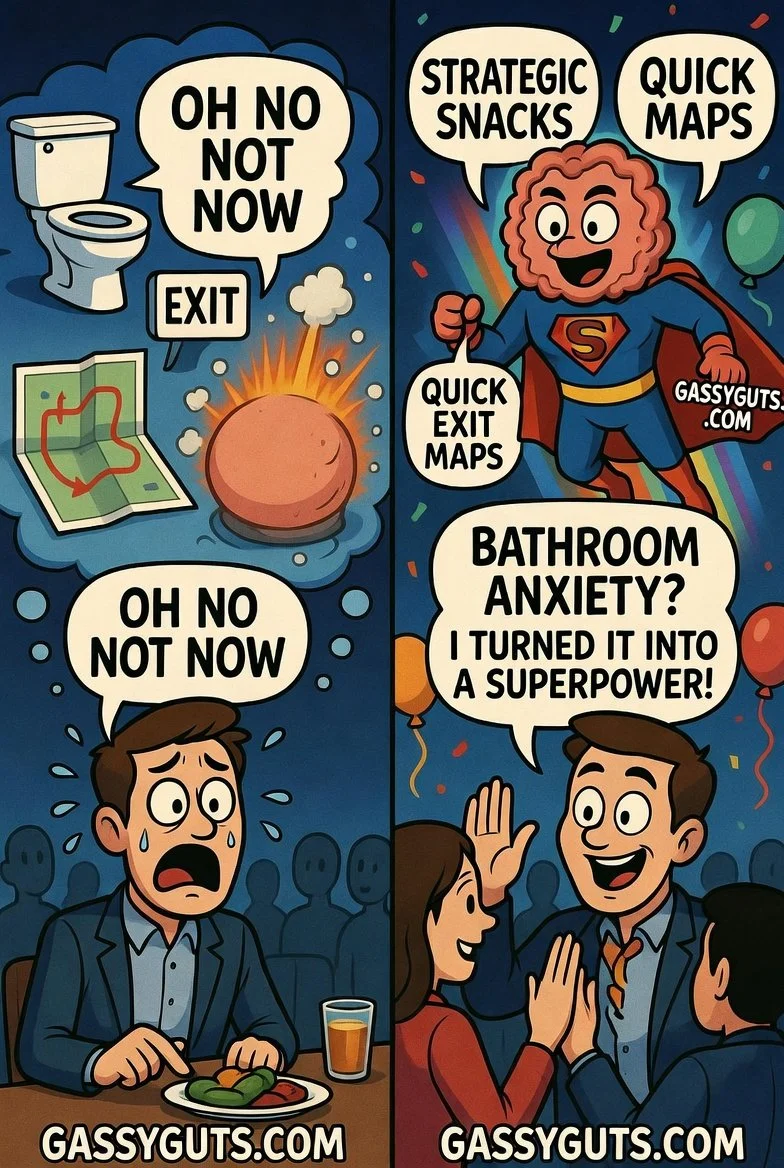
An emergency plan for when the tummy starts turning’ goes a LONG way!
Restaurants With IBS: How to Eat Out Without Turning the Menu Into a Crime Scene
Eating out with IBS can feel like trying to choose a meal while defusing a bomb with salad tongs. Menus are full of hidden triggers: garlic, onion, dairy, wheat, fried foods, creamy sauces, spicy oils, artificial sweeteners, giant portions, carbonated drinks, alcohol, and “healthy” ingredients that your gut may treat like tiny fireworks. The answer is not to avoid restaurants forever. That is how IBS steals your life one declined invite at a time.
Start by choosing the restaurant when possible. This is not controlling. This is accessibility. People with allergies choose restaurants carefully. People with mobility needs think about entrances and seating. People with IBS can think about bathroom access, menu flexibility, timing, and food options. Call it digestive logistics. Sounds official. Humans love official names for basic survival.
Look at the menu before you go. Identify two or three safer options. For many people, that might mean grilled protein, rice, potatoes, eggs, simple cooked vegetables, soup without heavy cream, sourdough or gluten-free options if tolerated, or sauces on the side. For others, it may mean asking about onion and garlic, choosing smaller portions, avoiding fried appetizers, or eating part of the meal and taking the rest home. The win is not perfect digestion. The win is avoiding the “I guess I will panic-order something random” spiral.
The Johns Hopkins Medicine FODMAP guide describes the low-FODMAP diet as a temporary, restrictive eating plan used to identify troublesome foods in IBS. It also emphasizes reintroduction. That matters socially. If FODMAP has helped you, use what you learned. If FODMAP made your food fear worse, GassyGuts gives you permission to stop treating it like a sacred personality test. Restriction can be a tool. It should not become a tiny beige prison where every dinner invitation dies.
This is where the Phyto Diet lens can be helpful. Through GassyGuts gut health reset services, the Phyto Diet is positioned as a practical, plant-forward, gut-supportive framework that focuses on phytonutrients, food quality, personalization, and digestive resilience rather than endless fear-based elimination. For social eating, that means asking: what can I add over time, what can I tolerate now, what can I modify, and what patterns help me feel more confident? It is less “never eat this again” and more “build a smarter relationship with food, one tolerable step at a time.”
Bathroom Anxiety: The Unsexy Skill Nobody Wants and Many People Need
Bathroom anxiety is one of the biggest reasons IBS ruins social life. It is the fear of needing a bathroom and not finding one. The fear of taking too long. The fear of sounds. The fear of smell. The fear of someone asking if you are okay. The fear of being trapped in a car, meeting, movie row, plane, elevator, church pew, or any other human invention clearly designed by people with cooperative colons.
The first move is practical: know the bathroom situation. Check the restaurant layout. Pick an aisle seat. Drive separately when possible. Use apps or maps to identify public bathrooms. Arrive early. Sit near exits. Choose events where leaving briefly is normal. This is not weakness. This is tactical bowel citizenship.
The second move is psychological: reduce the mystery. Anxiety grows in vague space. “What if something happens?” is huge and shapeless. Better questions shrink it: Where is the bathroom? What is my exit plan? Who can I tell? What food choices are lower risk? What will I do if I flare? What is the least dramatic way to leave? Once your brain has answers, it may stop screaming quite so theatrically.
The third move is exposure, gently. If you have avoided social life for months or years, jumping straight into a six-hour concert after chili nachos is not courage. It is a documentary waiting to happen. Start with small outings: a coffee shop near home, a walk with a trusted friend, a short lunch at a familiar place, a movie where you sit on the aisle, a low-stakes errand after eating a known meal. Your nervous system needs new evidence. It cannot build confidence from your couch alone, tragic little throne though it may be.
The fourth move is honest language. You do not owe everyone your medical history. Still, one or two trusted people can make social life easier. Try simple scripts: “My stomach is unpredictable, so I may need to step out or leave early.” “I am dealing with IBS, and planning around bathrooms helps me actually show up.” “I want to come, but I need a restaurant with simple options.” If someone responds with cruelty, congratulations, your gut just helped screen your social circle. A weird gift, but a gift.
Dating With IBS: Romance, Vulnerability, and the Treacherous Burrito Question
Dating with IBS deserves its own survival manual and possibly a tiny medal. You are trying to be charming while also wondering if the restaurant bathroom has acoustics designed by your enemies. You want chemistry, eye contact, ease, maybe a little mystery. IBS brings a different kind of mystery, generally involving urgency, bloating, and the question “Can I wear jeans after 6 p.m.?”
First-date strategy matters. Choose a place with food you know, bathrooms you can access, and an easy exit. Coffee, tea, a walk, a casual lunch, or a low-pressure activity may feel safer than a four-course tasting menu where every dish arrives with foam, garlic, and consequences. You are allowed to make dating easier on your body. Love will survive a practical restaurant choice. If it cannot, it was probably flimsy anyway.
Disclosure can wait until you feel ready. You can say, “I have some digestive issues, so I like to keep food simple,” without delivering a TED Talk titled My Colon and Its Many Betrayals. As trust builds, you can share more. The right person will care about your comfort. The wrong person will make a joke that tells you everything you need to know. Convenient, really. Horrible, but efficient.
IBS can also affect intimacy. Bloating, gas, abdominal pain, fatigue, constipation, diarrhea, body image stress, and fear of symptoms can make physical closeness feel complicated. You are allowed to go slowly. You are allowed to plan around your better symptom windows. You are allowed to say, “My stomach is having a rough night, but I still want to spend time with you.” That sentence may feel vulnerable, but it is also honest. A relationship that requires you to pretend you have a decorative, silent digestive system is not a relationship. It is theater.
For more emotional normalization, GassyGuts already has pieces like Why living with IBS and IBD feels lonely and 9 things all people with IBS and IBD can relate to. Those articles matter because isolation is part of the problem. When people feel ashamed, they hide. When they hide, symptoms feel even bigger. When symptoms feel bigger, they cancel more. Then life shrinks. The antidote is not oversharing with every stranger who asks about brunch. The antidote is choosing safe people and giving yourself room to be human.
Friendships, Cancellations, and the Fine Art of Not Disappearing
IBS can turn you into the friend who cancels. Sometimes that is unavoidable. Symptoms flare. Urgency hits. Pain spikes. Fatigue rolls in. Bloating makes you feel like a parade balloon full of regret. You cancel because your body gave you the red light. Then guilt arrives, wearing dress shoes.
The fix is not to force yourself through every plan. That can create more fear, more symptoms, and more resentment. The fix is to communicate before the crisis. Tell your trusted friends what helps: flexible plans, restaurants with options, understanding when you leave early, walks instead of heavy meals, brunch at someone’s house, or plans that can shift without turning into an emotional trial.
Use replacement instead of disappearance. If you cancel, offer another specific option when possible: “I am flaring tonight, but I still want to see you. Can we do a walk Sunday morning?” or “Dinner is risky today. Could we do tea instead?” This protects the relationship and reminds your brain that one flare does not equal permanent exile from humanity.
For people with IBD, social life can involve extra layers: fatigue, medication schedules, flare uncertainty, dietary changes during active disease, and the emotional strain of a chronic inflammatory condition. The Crohn’s & Colitis Foundation daily life guide notes that people can build and maintain strong relationships while managing IBD, and that a strong support system values physical and emotional health. Their social life resource also highlights that managing IBD socially can involve relationships, mental health, body image, bullying, peer pressure, and intimacy. In other words, the social side is real medicine-adjacent territory, not a vanity problem.
Nearly 1 in 100 Americans lives with IBD, according to a Crohn’s & Colitis Foundation prevalence estimate. IBS and IBD are different conditions, but both can create social strain. GassyGuts covers that distinction in IBS vs. IBD: What’s the Difference, because confusing the two leads to sloppy advice. IBS social planning may focus on triggers, gut-brain loops, bowel patterns, and food confidence. IBD social planning may also require flare monitoring, medical treatment, inflammation control, and nutrition support during active disease. Both deserve compassion. Both deserve better than “just relax.”
Food Fear: When IBS Turns Eating Into a Suspicious Activity
Food fear is where IBS gets sneaky. At first, you cut one trigger. Sensible. Then another. Fine. Then another. Understandable. Suddenly your diet has the emotional range of printer paper, and you still have symptoms. This is how many people end up afraid of eating out, traveling, dating, or attending anything involving food, which unfortunately describes roughly 87% of human bonding rituals.
The problem is not that trigger awareness is bad. Trigger awareness is useful. The problem is when the search for safety becomes a smaller and smaller cage. Every symptom gets blamed on the last food eaten. Every food becomes suspicious. The person stops asking better questions: Was I constipated? Did I sleep poorly? Did I drink alcohol? Was I anxious? Did I eat quickly? Was the portion huge? Was there hidden onion or garlic? Did I skip meals then overload my gut? Am I in an IBD flare? Did I introduce too much fiber too fast? Did I start a new supplement? Did I drink carbonated beverages? Did I eat while standing over the sink like a raccoon with responsibilities?
This is why GassyGuts leans so hard into pattern recognition. The article Will this gut pain or gas ever stop? makes the larger point: gut pain, gas, bloating, cramping, urgency, constipation, diarrhea, and food sensitivity confusion usually require more than one magic food swap. The same applies to social life. The goal is not to find the one forbidden ingredient that explains your entire biography. The goal is to understand your digestive pattern well enough to make flexible decisions.
The American College of Gastroenterology IBS guideline includes dietary therapies and gut-directed psychotherapies among IBS management options, and discusses tools such as low-FODMAP trials, soluble fiber, and peppermint oil in specific contexts. That does not mean everyone should grab random supplements or self-prescribe a protocol from a comment section. Please do not let a stranger named GutWarrior1978 become your medical team. It means IBS care can be broad, personalized, and layered.
If food fear is taking over, the GassyGuts path is not “eat everything and hope.” It is also not “remove everything and call it healing.” It is a middle path: stabilize symptoms, identify patterns, protect nutrition, reintroduce strategically when appropriate, support plant diversity where tolerated, and build confidence. The ultimate diet guide for naturally healing IBS and IBD and 9 natural remedies for IBS and IBD can support that ecosystem, while the Phyto Diet framework gives a more expansive alternative to endless subtraction.
A Social-Life Flare Plan: Because Hope Is Nice, But Plans Are Better
Every person with IBS needs a social-life flare plan. A flare plan is not pessimism. It is kindness with a clipboard. It keeps a bad gut day from becoming a full identity collapse.
Your plan should answer five questions. First, what are my early warning signs? Maybe your urgency increases, your abdomen tightens, your stool pattern changes, your cramps start, your appetite drops, or your anxiety spikes. Second, what usually helps? Heat, hydration, a familiar meal, medication approved by your clinician, walking, rest, peppermint oil if appropriate, breathing, low-stimulation time, or calling the plan early. Third, what should I avoid during a flare? That may include alcohol, greasy food, very spicy food, large meals, carbonated drinks, high-FODMAP foods, raw roughage, or intense workouts, depending on your pattern. Fourth, when do I need medical support? Blood in stool, black stool, unexplained weight loss, fever, persistent vomiting, dehydration, nighttime diarrhea, severe pain, anemia, or a major change in symptoms deserves proper medical follow-up. Fifth, how do I communicate without vanishing?
Communication scripts are underrated. Here are a few that sound human instead of like you are reading from a hospital discharge packet: “My gut is flaring today, so I need to keep this low-key.” “I can still come, but I may head out early.” “Food is tricky today. Could we meet after dinner?” “I am not ghosting you. My digestive system is currently staging a tiny coup.”
For travel, make the plan more specific. Pack your safe snacks. Bring medication approved by your doctor. Choose aisle seats when possible. Research bathrooms. Avoid testing brand-new foods right before flights or long car rides. Build buffer time into your schedule. If you are traveling with friends, tell one trusted person what would help. You do not need a dramatic confession by baggage claim. A simple “I have IBS, so I plan around bathrooms and food a bit” can prevent a lot of silent panic.
For work events, eat strategically beforehand if the catered food is risky. Hold a drink that works for you. Ask for modifications quietly. Sit near an exit. Give yourself permission to step away. And remember that most people are thinking about themselves, their inbox, their outfit, their awkward small talk, and the slow death of fluorescent lighting. They are probably not tracking your bathroom trips with the intensity your anxious brain imagines.
Use the Gut-Brain Connection Without Turning It Into Blame
IBS articles often say “stress makes IBS worse,” and then leave the reader feeling blamed, as if they personally invented cortisol. The gut-brain connection is real. It is also wildly misused. Stress affecting your gut does not mean your symptoms are imaginary. It means your nervous system and digestive system are connected because the human body was apparently designed by a committee that loved complications.
Gut-brain support can be practical. Slow breathing before leaving the house. A short walk after meals. Better sleep routines. Gentle movement. Therapy if anxiety, trauma, panic, or avoidance is trapping your life. Gut-directed hypnotherapy or CBT-informed strategies when available. Journaling that tracks patterns rather than self-blame. A calm phrase you practice before outings: “I have a plan. I can leave. I can handle discomfort. This is not danger.”
GassyGuts has already covered this in How to relax your gut, and that article fits naturally into this pillar because social life is nervous-system territory. If your gut has learned that restaurants, crowds, travel, or dating equal threat, your body may need repeated safe experiences, not one motivational quote slapped onto a sunset.
This is also why “push through” often fails. Pushing through can be useful sometimes, but if every outing feels like a threat, your nervous system may double down. A better method is graded confidence. Choose easier plans first. Keep them short. Repeat them. Build wins. Then expand. Your gut learns through experience, and your brain learns through proof. Annoying, yes. Effective, also yes.
The GassyGuts Social-Life Strategy: Live Bigger Without Pretending Your Gut Is Fine
The GassyGuts social-life strategy is simple, but not shallow: prepare, personalize, communicate, regulate, and rebuild. Prepare by knowing your patterns, your safer foods, your bathroom options, and your flare plan. Personalize because IBS-D, IBS-C, IBS-M, IBD, food sensitivities, bloating, constipation, urgency, and stress-reactive symptoms need different tools. Communicate with trusted people so you stop carrying everything alone. Regulate your nervous system so every plan does not feel like a threat. Rebuild your food and life tolerance gradually, instead of swinging between reckless freedom and total restriction.
This is where the GassyGuts blog functions like an ecosystem instead of a pile of random gut posts. If you feel dismissed after diagnosis, read Diagnosed with IBS but given no answers. If gas and pain are wearing you down, read Will this gut pain or gas ever stop?. If you feel alone, read Why living with IBS and IBD feels lonely. If you need a bigger reframe, read How to finally start living with IBS and IBD. If you want the lighter, “please let me laugh because otherwise I may scream” version, read Living and laughing with IBS.
The real win is not becoming the person with a perfect gut. The real win is becoming the person with a plan. A person who can say yes more often. A person who can choose restaurants with less fear. A person who can date with honesty. A person who can travel with preparation. A person who can cancel without disappearing. A person who can eat with more information and less panic. A person who realizes IBS may influence life, but it does not get to own the deed.
You may still have flares. You may still have awkward bathroom moments. You may still have meals that betray you with the enthusiasm of a tiny digestive soap opera. That does not mean you failed. It means you are managing a chronic condition in a world that insists on centering social life around food, sitting still, traffic, and bathrooms placed by architects with suspiciously calm intestines.
If IBS has been shrinking your world, GassyGuts is where the fight gets smarter. Explore the GassyGuts gut health reset services, dig into the GassyGuts blog, and start building a plan that gives you more than symptom panic and food fear. Your gut may be dramatic. Your life still deserves friends, dinners, dates, road trips, laughter, and the occasional brave restaurant reservation. Let the gut bring its clipboard. You are bringing a strategy.
Done letting IBS play bouncer at the door of your own life? Start with GassyGuts, explore the GassyGuts gut health reset services, and build a plan that respects your symptoms without shrinking your world into five safe foods, three excuses, and one emergency bathroom map. Your social life deserves better. So does your gut.
